April 15, 2026
Airace FX6i vs Navon: Which RTK Receiver Is Right for You?
By Swayambhu Mohanty, Co-founder, Airace Technologies
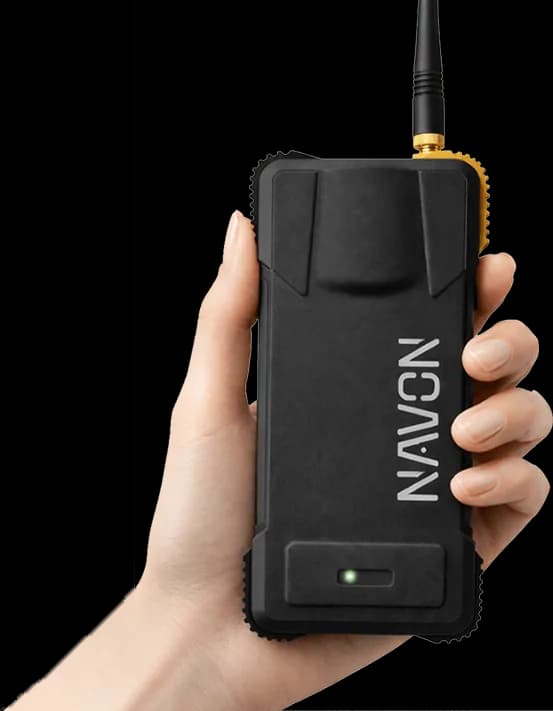
The Airace FX6i and Airace Navon are the two most-asked-about receivers in our lineup. Both are survey-grade, Made-in-India, and field-tested across thousands of projects. So which one is right for you? This comparison gets you to a decision in a few minutes.
The short answer
Choose the FX6i if you need a reliable, daily-driver RTK rover for cadastral, agricultural, road, and general construction work.
Choose the Navon if you need the absolute best fix availability under canopy, IMU tilt compensation, an integrated laser for inaccessible points, and the longest battery life, for mining, large infrastructure, and the most demanding survey contracts.
Side-by-side comparison
| Feature | Airace FX6i | Airace Navon |
|---|---|---|
| Channels | 1,408 | 1,408 (next-gen chipset) |
| Constellations | GPS, GLONASS, Galileo, BeiDou, QZSS, NavIC | GPS, GLONASS, Galileo, BeiDou, QZSS, NavIC, SBAS |
| RTK Horizontal Accuracy | 8 mm + 1 ppm | 8 mm + 1 ppm |
| RTK Vertical Accuracy | 15 mm + 1 ppm | 15 mm + 1 ppm |
| IMU Tilt Compensation | , | Yes (up to 60°) |
| Integrated Laser | , | Yes |
| IP Rating | IP67 | IP67 |
| Operating Temperature | -40°C to +65°C | -40°C to +65°C |
| Battery Life (RTK rover) | 12+ hours | 15+ hours |
| Communication | 4G, Bluetooth, Wi-Fi, UHF | 4G, Bluetooth, Wi-Fi, UHF, eSIM |
| Best for | Cadastral, agriculture, general survey | Mining, infrastructure, demanding sites |
Where the differences matter in the field
Under canopy and in urban canyons
Both receivers track NavIC, which significantly improves fix availability in Indian latitudes. The Navon's next-generation chipset and SBAS support give it a measurable edge in dense forest canopy and tight urban survey work, typically 10–20% faster re-acquisition after signal loss.
When you can't hold the pole vertical
This is the single biggest workflow difference. With the FX6i, you must level the pole bubble for every point. With the Navon's IMU, you can tilt up to 60° from vertical and still get an accurate point, measure building corners, fence lines, drain inverts, and stockpile edges without contortions. Survey crews report 25–40% faster point capture once they trust tilt compensation.
Inaccessible points
The Navon's integrated laser distance meter lets you measure points you physically can't put a pole on — across a river, on a rooftop, behind a wall, under live power lines. The FX6i and FX6i-Laser share identical GNSS, IMU, battery, and ruggedness specifications; the Laser variant adds only the integrated laser module (≤ 5 cm at 20 m).
Battery on long survey days
FX6i: 12+ hours per charge. Navon: 15+ hours. For a typical 8-hour day both are fine. For double-shift work or remote sites without charging, the Navon's extra runtime matters.
Total cost
The FX6i is the everyday platform, typically the right answer when you need to equip multiple crews and the work is straightforward cadastral or construction layout. The Navon consolidates IMU, laser, and the latest chipset into a single rover for the most demanding sites.
What's the same
Both receivers share Airace's core platform:
- 1,408-channel multi-frequency tracking with NavIC
- Survey-grade 8 mm horizontal accuracy
- IP67 magnesium-alloy housing built for Indian field conditions
- Native integration with the Airace One field-data app and Geo Studio post-processing software
- Same-day engineering support from Airace's Indian team
- 3-year warranty and pan-India service
Decision flow
Ask yourself:
- Do you regularly measure points where you can't hold a pole vertical? If yes → Navon (or FX6i-Laser). If no → FX6i is enough.
- Do you survey inaccessible points (across water, rooftops, behind obstructions)? If yes → Navon or FX6i-Laser.
- Are you equipping multiple field crews? FX6i wins on fleet efficiency.
- Is the work primarily mining, large infrastructure, or specialized survey contracts? Navon is the right tool.
Still not sure?
Both receivers are field-deployed by hundreds of Indian surveying firms today. The fastest way to decide is a hands-on demo with your own use case. Request a demo, or view the full comparison page for spec-by-spec detail.