April 8, 2026
NavIC Support in GNSS Receivers: Why It Matters for Indian Surveyors
By Harish Mohanty, Chief Technology Officer, Airace Technologies
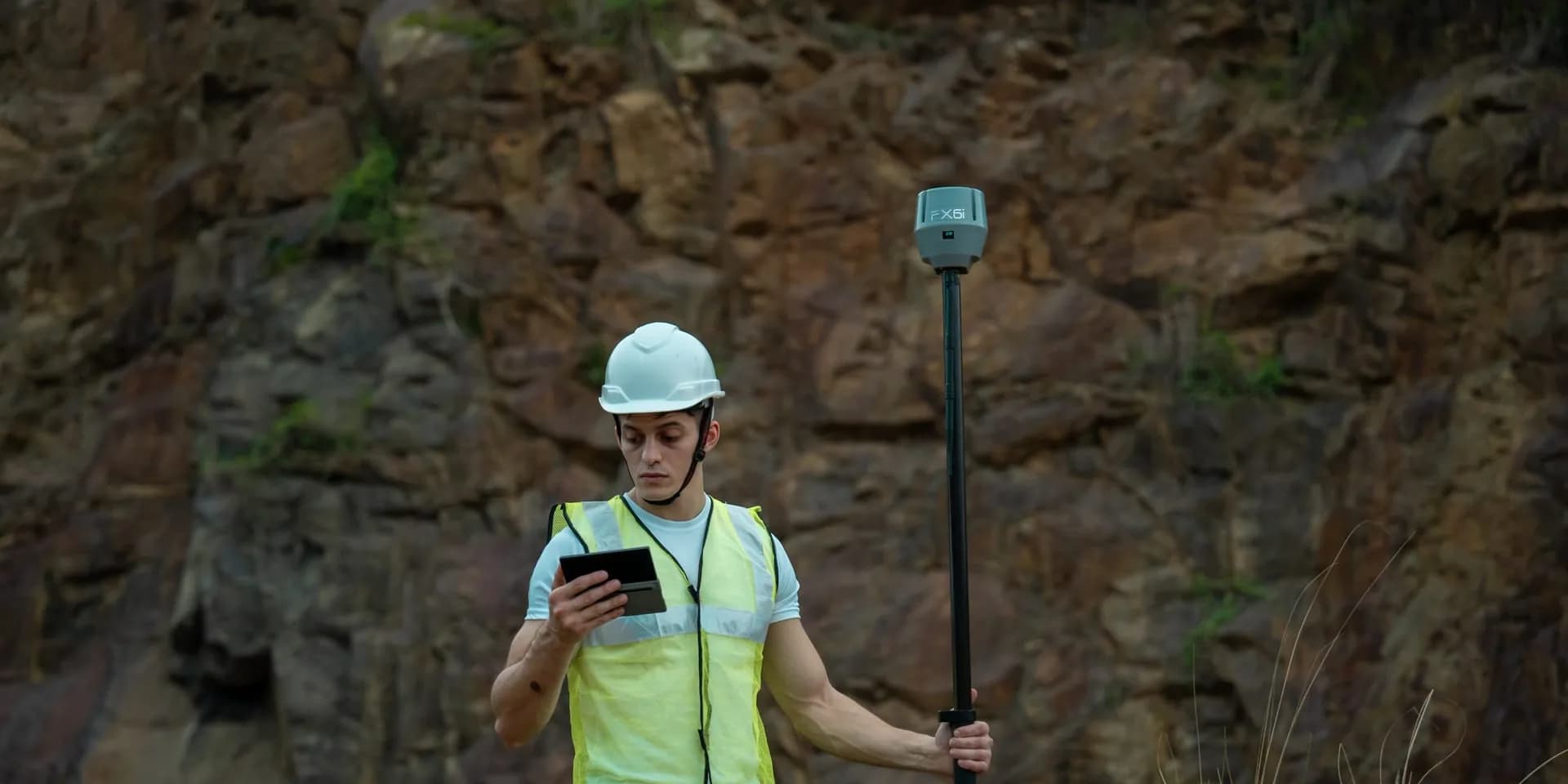
NavIC, the Navigation with Indian Constellation, is India's regional satellite navigation system, operated by ISRO. For Indian surveyors, NavIC is no longer a "nice-to-have" tick-box on a spec sheet. In 2026, receivers that track NavIC deliver measurably better fix availability, faster RTK initialization, and more reliable centimetre accuracy across the Indian subcontinent. This article explains what NavIC is, why it matters for survey work, and what to look for when buying a NavIC-capable receiver.
What is NavIC?
NavIC (formerly IRNSS, Indian Regional Navigation Satellite System) is a constellation of seven satellites operated by the Indian Space Research Organisation (ISRO). Three satellites are in geostationary orbit and four are in inclined geosynchronous orbits, providing dedicated coverage over India and a region extending roughly 1,500 km beyond the country's borders.
NavIC broadcasts on two frequencies relevant to civilian receivers:
- L5 band (1176.45 MHz), open service, used by survey-grade GNSS receivers
- S-band (2492.028 MHz), open service, with growing support in next-gen chipsets
NavIC is designed to provide standalone positioning over the Indian region without dependency on foreign-controlled constellations like GPS (USA), GLONASS (Russia), Galileo (EU), or BeiDou (China).
Why NavIC matters for Indian surveyors
1. Better satellite geometry over India
GPS satellites are optimized for global coverage, which means at Indian latitudes (roughly 8°N to 37°N) the satellite geometry is often suboptimal, particularly for vertical accuracy. NavIC's geostationary and geosynchronous satellites sit consistently high in the sky over India, improving Position Dilution of Precision (PDOP) and giving you better vertical accuracy on demanding sites.
2. More satellites means faster RTK fixes under canopy
Surveying under tree canopy, between buildings, or in narrow valleys is where weak GNSS reception kills productivity. Adding NavIC satellites to GPS, GLONASS, Galileo, and BeiDou tracking can mean the difference between waiting two minutes for a fix and getting one in 15 seconds. More tracked satellites = more redundancy = faster, more reliable RTK initialization.
3. Independent of foreign systems
For government, defence, and strategic infrastructure projects, dependency on US- or Chinese-controlled satellite systems is a real concern. NavIC provides sovereign positioning capability, and several Indian government tender specifications now mandate NavIC support.
4. India-first chipset optimisation
Receivers designed in India can tune algorithms for NavIC's specific signal structure and orbital characteristics, extracting better performance than chipsets that treat NavIC as an afterthought. This is one reason Made-in-India receivers like the Airace FX6i and Navon often outperform imported brands at the same price point on Indian sites.
What NavIC support actually means in a receiver
"Supports NavIC" can mean different things. When evaluating a receiver, ask:
1. Which NavIC frequencies?
L5 is the minimum. Receivers that also track S-band have additional ionospheric error correction capability and better resistance to multipath in urban environments.
2. How many NavIC channels?
A receiver that allocates only 7 channels to NavIC (one per satellite) cannot follow signal multipath or backup channels. Modern receivers allocate 14+ channels to NavIC.
3. Is NavIC included in the RTK engine?
Some receivers track NavIC for visualization but don't use it in the RTK position solution. Confirm that NavIC observables are processed by the RTK engine and used in centimetre-level positioning, not just plotted on a satellite skyview.
4. Does the field software show NavIC status?
The data-collection app should display NavIC satellite count, signal strength, and inclusion in the fix. If the app doesn't show NavIC, you can't verify it's being used.
Real-world impact: NavIC on Indian survey sites
Across deployments of the Airace FX6i and Navon receivers, we see consistent improvements when NavIC is enabled:
- 15–30% faster RTK initialization in canopy and semi-obstructed environments
- 10–20% improvement in vertical accuracy under standard sky conditions
- Significant reduction in fix loss in narrow urban surveys, between high-rise buildings, and in dense forest
- Better reliability in cyclone-affected coastal regions where ionospheric activity disrupts GPS-only solutions
Government & tender requirements
Several Indian government departments and PSU tenders now mandate NavIC support for survey equipment:
- Survey of India
- National Highways Authority of India (NHAI)
- State PWDs and irrigation departments
- Indian Railways' track survey contracts
- Forest department FRA (Forest Rights Act) plot mapping
- Various PMGSY and Jal Jeevan Mission projects
If you're bidding on government work, NavIC support is rapidly moving from "preferred" to "required." Imported receivers without genuine NavIC support are increasingly disqualified at the technical-bid stage.
Bottom line
NavIC is no longer an exotic feature, it's a baseline capability for any survey-grade GNSS receiver sold in India in 2026. If your current receiver doesn't track NavIC, you're leaving accuracy, productivity, and tender eligibility on the table.
Made-in-India receivers like the Airace FX6i, FX6i-Laser, and Navon are designed from the chipset up to track NavIC across all current frequencies, with full NavIC integration in the RTK engine and field software.
Talk to our team if you'd like to see NavIC performance on your own site, or read more guides on Indian surveying best practices.