April 25, 2026
NavIC vs GPS: What Indian Surveyors Need to Know in 2026
By Harish Mohanty, Chief Technology Officer, Airace Technologies
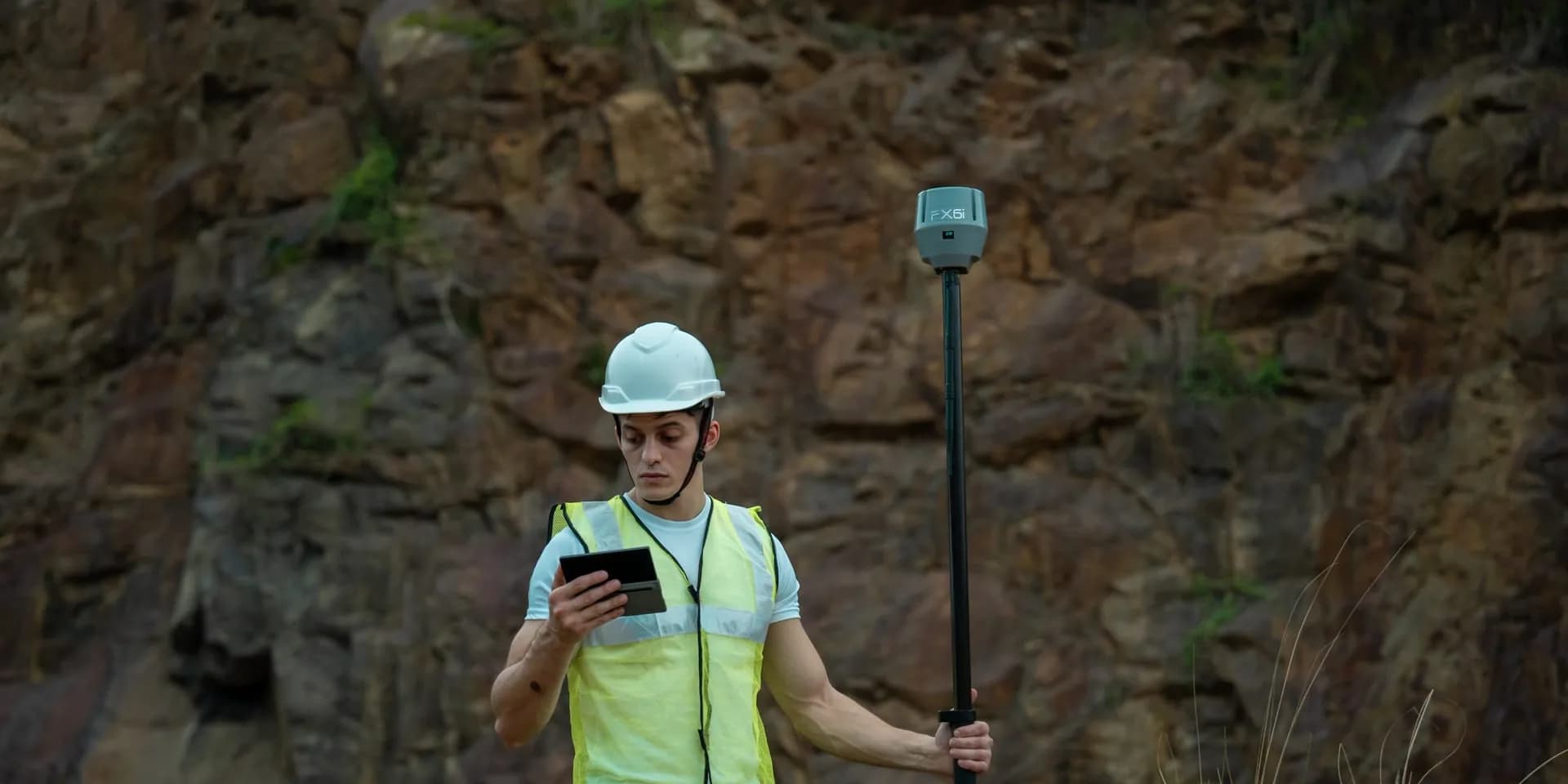
"Does it support NavIC?" is now the first question Indian surveyors ask about a new GNSS receiver. The second is usually "but what does that actually do that GPS doesn't?" This article answers both, comparing NavIC and GPS on the dimensions that matter for centimetre-grade survey work in India.
The 30-second answer
GPS (Global Positioning System) is the US-operated global constellation of 31 satellites, it works everywhere on Earth and is the baseline for every GNSS receiver. NavIC (Navigation with Indian Constellation, formerly IRNSS) is India's regional system of 7 satellites that focuses dedicated coverage over the Indian subcontinent.
You don't choose between them. You use both, and Galileo, GLONASS, and BeiDou alongside. The more satellites your receiver tracks, the faster and more reliable your RTK fixes. NavIC's value is that it adds India-optimised satellite geometry to a multi-constellation solution.
Side-by-side comparison
| Dimension | GPS | NavIC |
|---|---|---|
| Operator | US Space Force (USA) | ISRO (India) |
| Satellites | 31 active | 7 active |
| Coverage | Global | India + ~1,500 km buffer |
| Orbit type | MEO (medium Earth orbit) | GEO + GSO (geostationary + geosynchronous) |
| Civilian frequencies | L1, L2, L5 | L5, S-band |
| Standalone civilian accuracy | ~3–5 m | ~5–10 m |
| RTK-grade accuracy | 8 mm + 1 ppm (with corrections) | 8 mm + 1 ppm (with corrections) |
| Ionospheric correction model | Klobuchar | NavIC Grid Ionospheric Correction |
| First operational | 1995 | 2018 |
| Sovereign control | , | Yes (India) |
Where NavIC genuinely outperforms GPS-only over India
1. Vertical accuracy
GPS satellites are optimised for global coverage. At Indian latitudes their geometry is tilted, which weakens vertical Position Dilution of Precision (VDOP). NavIC's geostationary satellites sit consistently high in the sky over India, contributing direct overhead measurements that improve elevation accuracy on demanding sites, bridge decks, airport runways, dam crests.
2. Fix recovery under canopy
In dense forest, plantations, or under tree-lined urban roads, you may lose 3–5 GPS satellites at any given moment. The NavIC GEO satellites, being stationary, give you a stable signal source that doesn't drift in and out as you move. Receivers that genuinely include NavIC in the RTK engine recover fixes 15–30% faster in these conditions.
3. Multipath resistance in cities
Urban canyons reflect GPS signals off glass towers, causing multipath errors. NavIC's S-band signal (2492 MHz) has different multipath characteristics than GPS L1 (1575 MHz), and combining both bands lets the receiver detect and reject multipath-corrupted measurements.
4. Sovereign continuity
For government, defence, and strategic infrastructure (railways, ports, power grid), reliance on US-controlled GPS is a procurement concern. NavIC provides a guaranteed sovereign positioning capability, and Indian government tenders increasingly mandate it.
Where GPS still leads
1. Sheer satellite count
31 GPS vs 7 NavIC. Anywhere in the world (including India), GPS will always contribute more satellites to a fix.
2. L-band signal maturity
GPS L1, L2, and L5 have decades of receiver firmware and ionospheric modelling refinement. NavIC L5 and S-band are newer; chipset support is less universal, particularly outside India-designed receivers.
3. Global use cases
If your survey work crosses into Nepal, Bhutan, Sri Lanka, or further afield, NavIC coverage drops off and you depend more on GPS plus the other global systems.
Practical guidance for buyers
What to look for in a receiver
- Multi-constellation tracking, GPS L1/L2/L5 + GLONASS + Galileo + BeiDou + NavIC L5 + QZSS at minimum.
- NavIC in the RTK engine, not just the satellite skyview. Confirm the data sheet mentions NavIC observables in the RTK position solution.
- 14+ NavIC channels, enough for 7 satellites plus multipath-rejection redundancy.
- S-band support, a 2026 differentiator for receivers built specifically for Indian conditions.
- Field software that displays NavIC status, if the app doesn't show NavIC satellite count and inclusion in the fix, you can't verify it's being used.
What to ignore
"Supports NavIC" with no spec-sheet detail. Some imported receivers tick the NavIC box but allocate minimal channels, track only L5, and don't actually use NavIC in the RTK engine. Ask for the data sheet, not the brochure.
How Airace receivers handle NavIC
Every Airace receiver, FX6i, FX6i-Laser, and Navon, tracks NavIC L5 with full integration in the RTK engine. The Navon adds S-band tracking and dual-band NavIC observables, optimised for Indian survey conditions including dense canopy work and urban infrastructure projects.
Across 1,200+ deployments we consistently see 15–30% faster RTK initialisation with NavIC enabled, and noticeably better vertical accuracy on government infrastructure contracts.
Bottom line
NavIC vs GPS is the wrong framing. The right framing is GPS + NavIC + GLONASS + Galileo + BeiDou, and a receiver that genuinely uses all of them in the RTK engine. For Indian surveyors in 2026, NavIC is no longer a tick-box feature; it's a practical productivity advantage and an increasingly common tender requirement.
Talk to our team to see NavIC performance on your own site, or compare the Airace receivers.