May 7, 2026
Airace FX6i vs Emlid Reach RS3: RTK GNSS Comparison for Indian Surveyors (2026)
By Swayambhu Mohanty, Co-founder, Airace Technologies
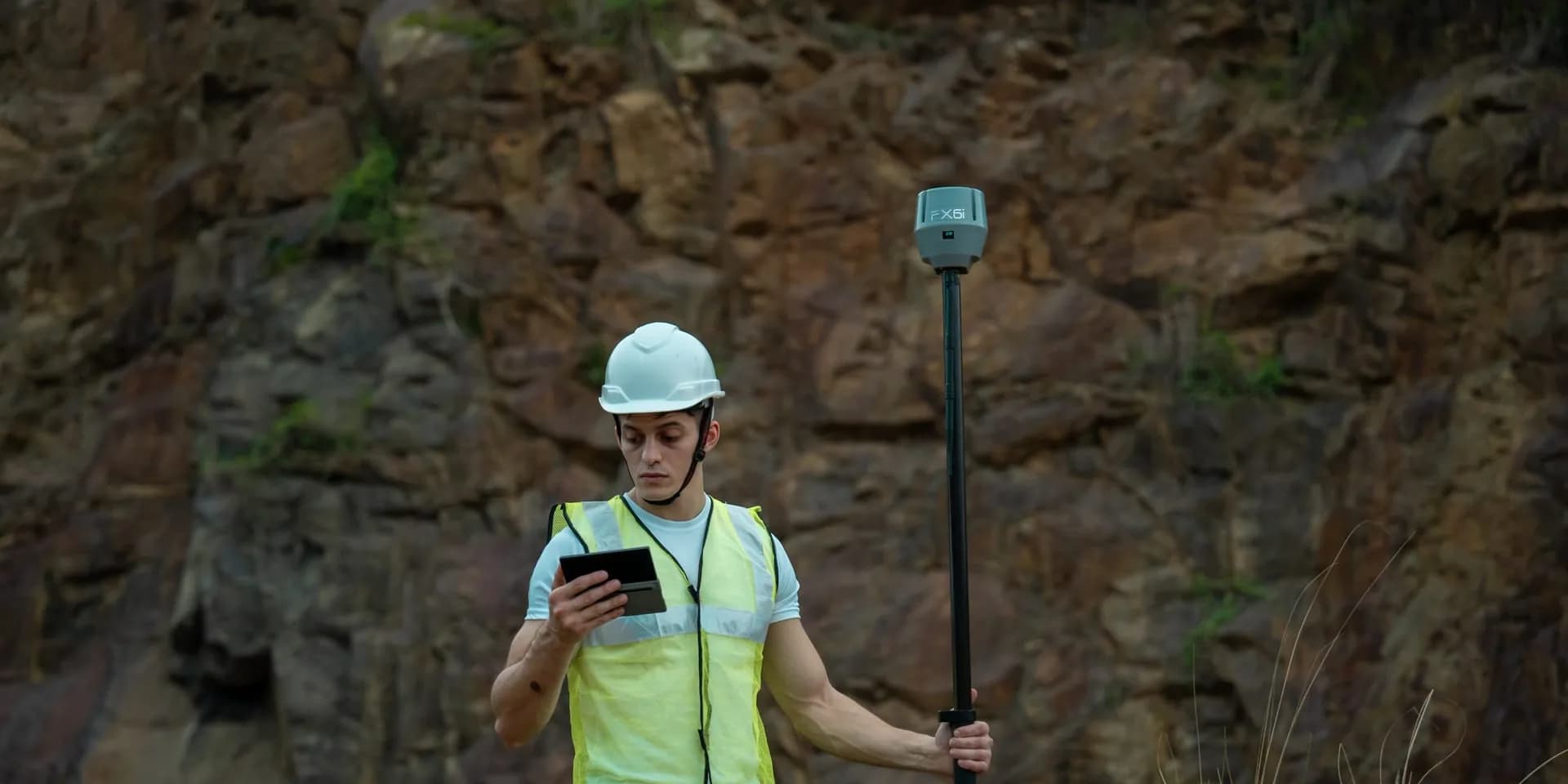
The Airace FX6i and the Emlid Reach RS3 are the two most frequently compared RTK GNSS receivers among Indian surveyors in 2026. Both are multi-band, centimetre-accurate, and priced well below Leica or Trimble. This comparison covers specs, field performance, India-specific factors, and the use cases where each receiver wins.
Quick verdict
The Emlid RS3 is a mature, globally validated receiver with an excellent community ecosystem and strong international support. The Airace FX6i is a Made-in-India receiver with NavIC support, a comparable spec sheet, and strong value in India — with same-day local support. For most Indian surveyors, the choice comes down to whether global community trust or India-specific value and NavIC integration matters more to your practice.
Specs comparison
| Specification | Airace FX6i | Emlid Reach RS3 |
|---|---|---|
| Constellations | GPS, GLONASS, Galileo, BeiDou, NavIC, QZSS, SBAS | GPS, GLONASS, Galileo, BeiDou, QZSS, SBAS |
| NavIC (IRNSS) support | Yes | No |
| Channels | 1,408 | 184 |
| Frequencies | L1, L2, L5 | L1, L2, L5 |
| RTK Horizontal Accuracy | 8 mm + 1 ppm | 7 mm + 1 ppm |
| RTK Vertical Accuracy | 15 mm + 1 ppm | 14 mm + 1 ppm |
| IMU Tilt Compensation | Yes (up to 60°) | Yes (up to 60°) |
| Tilt Accuracy | 30 mm @ 30° tilt | 30 mm @ 30° tilt |
| IP Rating | IP67 | IP68 |
| Weight | 465 g | 860 g |
| Battery Life (Rover) | 20 hours | 22 hours |
| Bluetooth | 5.0 | 4.2 |
| Wi-Fi | Yes | Yes |
| 4G LTE / eSIM | Yes (external SIM) | Yes (eSIM) |
| UHF Radio | Yes (internal 1W) | Yes (LoRa, optional UHF) |
| Internal Storage | 32 GB | 256 MB (log buffer) |
| Field software | Airace One (Android) | ReachView 5 (free) / third-party |
| Origin | Made in India (Bangalore) | Russia / distributed globally |
Where the Airace FX6i wins
NavIC support — a meaningful advantage on Indian sites
The single most important India-specific difference: the FX6i tracks NavIC (IRNSS), India's regional satellite constellation operated by ISRO. The Emlid RS3 does not support NavIC. For Indian surveyors, NavIC adds 3–4 extra satellites in the sky at any given time across the subcontinent, which directly improves PDOP, speeds up RTK initialization under canopy, and is increasingly mandated on government tender specifications. On a dense-canopy or urban-canyon site in India, a NavIC-enabled receiver can acquire a fix in 15–20 seconds where a non-NavIC receiver takes 1–2 minutes.
Weight — FX6i is 44% lighter
At 465 g vs 860 g, the FX6i is significantly lighter on a survey pole held overhead for 8–10 hours. For cadastral survey work involving hundreds of points per day, weight fatigue is a real productivity factor. The RS3's weight is noticeable by mid-afternoon on long field days.
Local support and service in India
Emlid's India support operates through distributors, with repair and calibration involving international shipping in many cases. Airace has engineering teams in Bangalore and Bhubaneswar, pan-India dealer coverage, and same-day remote support. For a survey business where a broken receiver means lost billing days, local turnaround time matters.
Higher channel count
The FX6i tracks 1,408 channels vs the RS3's 184. A higher channel count means better satellite discrimination, more redundancy in multipath environments, and a more stable RTK engine under challenging conditions. In practice, the difference shows up on sites with building reflections, power line interference, and signal-degraded terrain.
Where the Emlid RS3 wins
Established global community and ecosystem
Emlid has been in market since 2014 and has built one of the largest independent GNSS communities globally. The Emlid community forum, YouTube tutorial ecosystem, and Reddit threads (r/Surveying, r/drones) represent hundreds of thousands of pages of independent user experience. For a surveyor starting from zero, the volume of answered questions, workflow guides, and integration tutorials around the RS3 is genuinely an asset that saves learning time.
ReachView 5 third-party integrations
Emlid's ReachView 5 software integrates with a wide range of third-party field apps — Field Genius, SurvCE, Mapit GIS, Mobile Topographer — in addition to Emlid's own tools. This is valuable for survey firms already invested in a specific field-app workflow. The Airace One app is capable and improving rapidly, but the breadth of RS3 third-party integrations is currently larger.
eSIM connectivity
The RS3 includes a built-in eSIM with Emlid Caster access. For surveyors working in areas with poor cellular coverage, the eSIM integration provides reliable correction link management without managing a separate SIM card. The FX6i uses an external SIM via the 4G module, which requires its own SIM provisioning.
IP68 vs IP67
The RS3 is rated IP68 (1.5 m submersion, 30 min) vs the FX6i's IP67 (1 m submersion). For work in tidal zones, flood-prone areas, or heavy monsoon conditions involving submersion risk, the RS3's extra protection headroom is a consideration.
Field accuracy — are they actually different?
On paper the RS3 quotes 7 mm + 1 ppm horizontal and 14 mm + 1 ppm vertical RTK accuracy — marginally better than the FX6i's 8 mm + 1 ppm and 15 mm + 1 ppm. In practice, for cadastral and construction survey work, both receivers deliver centimetre-accurate results that are indistinguishable within normal survey tolerances. The 1 mm on-paper difference is not meaningful in the field. Where real-world accuracy differences emerge is under canopy and in urban canyons — and that is where the FX6i's NavIC support and higher channel count close or reverse the gap in Indian conditions.
Software comparison
Emlid's ReachView 5 is mature, well-documented, and free. It supports NTRIP, LoRa, and base-rover configurations through a polished mobile interface. The Airace One app covers point collection, stakeout, COGO, road design, 7 Indian regional languages, and direct NTRIP integration. Airace One is designed specifically for Indian workflows, including Survey of India coordinate systems and Indian district-level projection presets. For Indian surveyors, language support and Indian datum presets are practically useful — ReachView 5 requires manual coordinate system configuration.
Which should you choose?
| You should choose the Airace FX6i if… | You should choose the Emlid RS3 if… |
|---|---|
| NavIC support is a priority or requirement | You need maximum third-party app compatibility |
| You need survey-grade accuracy with strong India-specific value | Your firm works on international projects requiring Emlid ecosystem |
| You want Indian technical support with fast local turnaround | You need eSIM connectivity out of the box |
| You're equipping multiple field crews | You prioritize a deep community of existing RS3 users |
| You want a lighter receiver for long daily field sessions | IP68 submersion rating is a requirement |
| You work on government projects mandating NavIC | You're integrating with SurvCE, Field Genius, or similar |
Bottom line
Both the Airace FX6i and Emlid RS3 are capable RTK GNSS receivers that deliver centimetre accuracy in standard surveying conditions. The RS3 has the edge in ecosystem maturity, global community, and brand recognition. The FX6i has the edge in India-specific performance (NavIC), weight, channel count, and local support quality. For an Indian surveyor buying their first or second professional RTK receiver in 2026, the FX6i delivers more relevant capability for Indian field work — especially for government tender work, multi-crew deployments, and any site where NavIC satellites improve fix availability.
For drone survey work or integration-heavy workflows already built around Emlid's ecosystem, the RS3 remains a strong choice.
Compare all Airace receivers or talk to the team to discuss which receiver fits your specific workflow.