May 7, 2026
Airace vs CHCNav vs Emlid: Best Mid-Range RTK GNSS Receiver for India (2026)
By Harish Mohanty, Chief Technology Officer, Airace Technologies
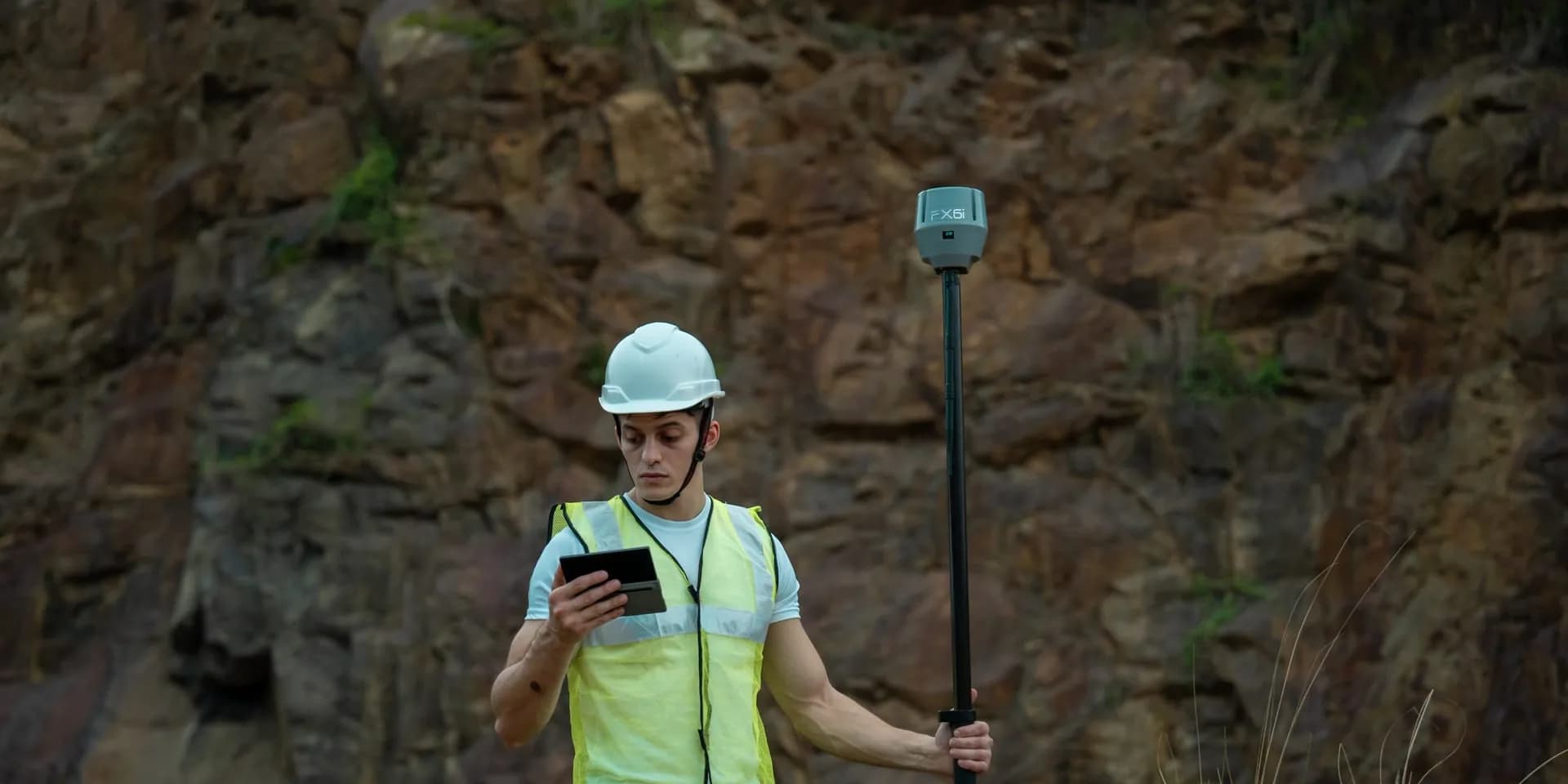
Three receivers dominate mid-range RTK GNSS conversations among Indian surveyors in 2026: the Airace FX6i, the CHCNav i83, and the Emlid Reach RS3. All three deliver centimetre-accurate RTK, multi-band tracking, and IMU tilt compensation at a fraction of Leica or Trimble pricing. This comparison cuts through the spec-sheet overlap to surface the differences that actually matter on Indian survey sites.
How these three receivers compare on paper
| Specification | Airace FX6i | CHCNav i83 | Emlid RS3 |
|---|---|---|---|
| Origin | India (Bangalore) | China (Shanghai) | Russia / Global |
| NavIC support | Yes | No | No |
| Channels | 1,408 | 1,408 | 184 |
| Frequencies | L1, L2, L5 | L1, L2, L5 | L1, L2, L5 |
| RTK Horizontal | 8 mm + 1 ppm | 8 mm + 1 ppm | 7 mm + 1 ppm |
| RTK Vertical | 15 mm + 1 ppm | 15 mm + 1 ppm | 14 mm + 1 ppm |
| IMU Tilt | Yes (60°) | Yes (60°) | Yes (60°) |
| IP Rating | IP67 | IP67 | IP68 |
| Weight | 465 g | ~680 g | 860 g |
| Battery (rover) | 20 hr | 14 hr | 22 hr |
| 4G LTE | Yes | Yes | Yes (eSIM) |
| UHF Radio | Yes (1W) | Yes (2W) | Yes (LoRa / optional UHF) |
| Field software | Airace One | LandStar 7 | ReachView 5 |
NavIC — where only one receiver wins
Of the three, only the Airace FX6i tracks NavIC (IRNSS), India's regional satellite constellation. CHCNav i83 and Emlid RS3 do not support NavIC. For Indian surveyors, this matters in three specific ways. First, NavIC satellites are positioned at high elevation angles over the subcontinent, improving vertical accuracy on sites where GPS geometry is poor. Second, the additional 3–4 NavIC satellites available at any given time accelerate RTK initialization under canopy and in urban canyons — conditions common across Indian survey sites. Third, several Indian government tenders, particularly DILRMP cadastral surveys and ISRO-linked projects, now specify NavIC-capable receivers, making NavIC support a commercial requirement rather than a nice-to-have. Neither the CHCNav i83 nor the Emlid RS3 can satisfy these tender specifications.
CHCNav i83 — strengths and limitations in India
The CHCNav i83 has built a strong reputation among Indian surveying firms since approximately 2019. Its LandStar 7 field software is considered one of the more capable survey apps in the mid-range segment, with good road design, stake-out, and COGO features. Indian surveyors on construction and highway projects frequently cite the i83's canopy performance and robust build quality. Its weaknesses in the Indian context are significant, however. No NavIC support means reduced satellite availability on Indian sites versus NavIC-capable receivers. As an imported product, service and calibration require the CHCNav distribution network, which can mean 2–3 week turnaround times for repairs. Battery life at 14 hours rover is the shortest of the three receivers compared here.
Emlid RS3 — strengths and limitations in India
The Emlid RS3 has the strongest global community of the three receivers. Independent YouTube tutorials, forum threads, and Reddit discussions give RS3 buyers more pre-purchase confidence and post-purchase support than any other mid-range receiver. In India, the RS3 works well for drone survey GCP collection, topographic surveys, and GIS data collection. Its IP68 rating provides the highest water ingress protection of the three. The limitations for Indian users are consistent with the FX6i comparison: no NavIC support, international support chain, and the heaviest weight of the three at 860 g. For firms that already use Emlid's ecosystem extensively — ReachView integrations, Emlid Caster — the RS3 is a natural continuation. For a surveyor buying their first professional RTK receiver in India, the ecosystem advantage is real but largely addresses a learning curve that resolves within a few months.
Airace FX6i — strengths and limitations
The FX6i is the only Made-in-India receiver in this comparison and the only one with NavIC support. The 465 g weight is the lowest of the three, meaningfully less fatiguing on high-point-count survey days. Battery life at 20 hours exceeds the CHCNav i83 and approaches the RS3. Local support from Indian engineering teams in Bangalore and Bhubaneswar means same-day response and typically same-week hardware resolution. The Airace One field app supports 7 Indian regional languages, Indian datum presets, and NTRIP integration with Indian CORS networks. The limitation is ecosystem maturity: Airace has fewer independent reviews, fewer third-party app integrations, and a smaller user community than either CHCNav or Emlid at this stage. Surveyors who rely heavily on community-driven troubleshooting will find fewer peer resources compared to the RS3 in particular.
Software comparison
LandStar 7 (CHCNav): The most feature-complete of the three proprietary apps, with mature road design, tunnelling, and construction layout tools. Requires Android data collector or can run on most Android tablets. Good documentation, Chinese origin but well-localised for English use.
ReachView 5 (Emlid): Clean, modern interface with deep third-party integration. Supports SurvCE, Field Genius, Mobile Topographer, and others. Free. Strong for users who want flexibility in their software stack. No Indian regional language support.
Airace One (Airace): Purpose-built for Indian field workflows. Covers point collection, stakeout, COGO, road alignment, NTRIP, and Indian datum presets. Available in Hindi, Odia, Telugu, Tamil, Kannada, Malayalam, and Bengali. Designed for individual surveyors who want a single-app solution that works out of the box in India.
India-specific buying considerations
Government tender requirements
DILRMP, NAKSHA, PMGSY, and Jal Jeevan Mission tenders increasingly specify NavIC support and Make-in-India sourcing. The FX6i is GeM-listed with PPP-MII Class-I certification. The CHCNav i83 and Emlid RS3 are imported products and do not qualify for Make-in-India procurement preferences on government tenders.
Input tax credit (ITC) on GST
The FX6i ships with a GST invoice from an Indian manufacturer, giving businesses full ITC reclaim rights. Imported receivers may come with distributor invoices where ITC recovery is more complex.
Currency exposure
CHCNav i83 and Emlid RS3 are imported products. The FX6i is built and supported in India with no currency exposure on hardware procurement.
Service and warranty
Airace offers 1-year hardware warranty with Indian service centres. CHCNav service typically goes through the distributor network (varies by region). Emlid offers international warranty with regional support. For survey businesses, a broken receiver that takes 3 weeks to repair has hard billing cost — local service speed should factor into purchase decisions.
Decision guide by use case
| Use case | Best choice | Why |
|---|---|---|
| Government DILRMP / NAKSHA cadastral | Airace FX6i | NavIC, GeM listing, Make-in-India eligibility |
| Construction staking and layout | CHCNav i83 or Airace FX6i | LandStar or Airace One both handle this well |
| Drone survey GCP collection | Emlid RS3 or Airace FX6i | Both work well; RS3 has more drone ecosystem guides |
| Survey-grade accuracy with Make-in-India value | Airace FX6i | NavIC, GeM listing, local support |
| Multi-crew equipping (3+ rovers) | Airace FX6i | Lower capital outlay per rover vs imports |
| Dense canopy or urban canyon work | Airace FX6i (NavIC) or CHCNav i83 | NavIC improves Indian-latitude canopy performance |
| Third-party app integration required | Emlid RS3 or CHCNav i83 | Larger third-party app ecosystems |
| Highway and railway alignment | CHCNav i83 or Airace FX6i | Both have LandStar / Airace One road tools |
| International project or export-facing survey work | Emlid RS3 or CHCNav i83 | More globally recognised brands |
Bottom line
All three receivers — Airace FX6i, CHCNav i83, and Emlid RS3 — deliver professional RTK GNSS accuracy for standard Indian survey work. The differences come down to NavIC support, Make-in-India eligibility, and ecosystem.
The CHCNav i83 is the most software-mature option and well-proven on Indian construction sites, with no NavIC and no Make-in-India advantages. The Emlid RS3 has the strongest global community and the best third-party integration, but no NavIC support. The Airace FX6i brings NavIC, Indian-language field software, and local support — the combination that best fits Indian survey economics in 2026, particularly for government project work and multi-crew deployments.
For experienced firms whose workflows are already built around CHCNav's LandStar or Emlid's ReachView ecosystem, switching costs are a real factor. For a new purchase decision, the FX6i's India-specific advantages are hard to ignore.
See all Airace receiver specifications, or request a field demo to test on your specific survey site conditions.