April 26, 2026
DILRMP & NAKSHA: Choosing the Right RTK GNSS Receiver for Cadastral Mapping (2026)
By Swayambhu Mohanty, Co-founder, Airace Technologies
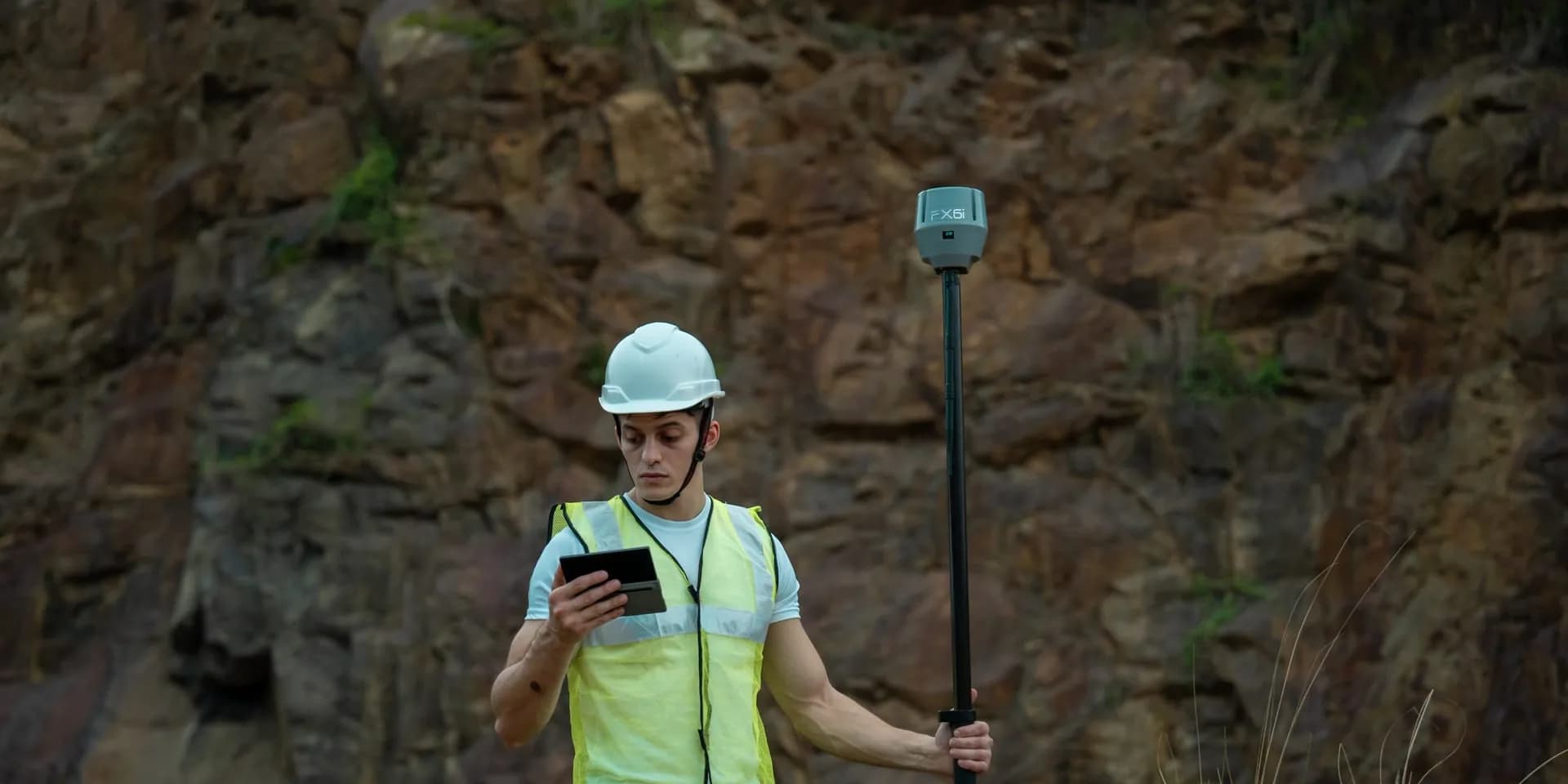
India is in the middle of the largest cadastral digitization push in its history. The Digital India Land Records Modernization Programme (DILRMP) is racing to close the ULPIN gap across roughly 3.3 lakh villages still pending geo-referenced cadastral mapping, and the NAKSHA pilot has carved out a ₹193.81 Cr execution window for urban land-records digitization across 150 cities in 26 states and 3 UTs. The hardware that does this work, RTK GNSS receivers, is being procured at an unprecedented scale through GeM, state tenders, and direct PSU orders.
This guide is for the people writing the BoQs, evaluating L1 bids, and signing the purchase orders. It walks through the receiver capabilities that actually matter for DILRMP and NAKSHA work, the procurement compliance that decides who can bid, and the field-level realities that decide whether the survey gets delivered on time.
Why DILRMP and NAKSHA need a different procurement lens
A cadastral survey is not a generic survey. The output isn't just a coordinate file, it's a legal record that has to integrate with the state's record-of-rights system, the ULPIN registry, and (eventually) the National Land Record Modernisation Programme's integrated stack. That puts three non-negotiable demands on the receiver:
- Geo-referenced output in the right CRS, UTM zones aligned to the state's notified coordinate system, with the ability to export in the formats the state DGSL or revenue department actually accepts (Shapefile, DXF, KML, CSV).
- Audit-ready logs, every point captured needs a timestamp, satellite count, fix type, HDOP, and (ideally) the correction source. Tenders increasingly ask for this in technical compliance.
- NavIC capability, Government of India procurement guidelines now expect indigenous constellation support. Receivers without NavIC L5 / S-band tracking are routinely disqualified at technical evaluation.
What the BoQ should actually specify
1. Multi-frequency, multi-constellation, NavIC-capable
Specify GPS (L1/L2/L5), GLONASS (L1/L2), Galileo (E1/E5a/E5b), BeiDou (B1/B2/B3), QZSS, and NavIC (L5 + S-band where available). A 1000+ channel chipset is the minimum for 2026 procurement. Anything less is previous-generation silicon being dressed up for a tender.
2. RTK accuracy spec
For cadastral work, the standard spec is 8 mm + 1 ppm horizontal RTK and 15 mm + 1 ppm vertical. Be specific in the BoQ, "centimetre accuracy" is too loose and lets sub-spec hardware in.
3. IMU tilt compensation
A 9-DOF IMU with 30°+ tilt compensation is now table-stakes. Cadastral surveys involve thousands of boundary points; any time saved per point compounds across a project. Insist on tilt as a mandatory line item.
4. IP-rated ruggedness
IP67 minimum. Field crews work through monsoons, dust storms, and high-humidity coastal zones. Receivers without IP rating fail in months and become spare-parts liabilities.
5. Battery life
20-hour battery life is the realistic target for a single-day cadastral campaign. Hot-swappable batteries are a bonus but not strictly necessary if the headline number is honest.
6. NTRIP and base/rover flexibility
The receiver must support NTRIP v2 with RTCM 3.x to consume Survey of India CORS, state CORS networks, and any departmental base stations. It should also be configurable as a base for districts where CORS coverage is patchy.
7. Field application and data export
The receiver is only as good as the field app it ships with. For DILRMP and NAKSHA, the app should: (a) be available in the local language, (b) export to Shapefile / DXF / KML / CSV, (c) work offline, and (d) sync to a project console for back-office QA.
Procurement compliance for GeM and state tenders
Beyond the technical spec, four compliance items decide who can actually deliver:
- Make-in-India OEM status, Class-I local content (50%+ domestic value addition) is increasingly preferred for purchase preference under PPP-MII. Verify the OEM's self-certification and supporting documents.
- GeM listing, A direct OEM listing on the Government e-Marketplace short-circuits the procurement timeline. Reseller-only listings often add margin and slow down deliveries.
- BIS compliance, Where applicable, the receiver should carry BIS / WPC certification for the radio modules used in UHF and 4G base/rover communication.
- Pan-India service network, Single-point repair from a metro doesn't scale. Insist on at least one authorised service centre per region and an SLA on turnaround.
L1 evaluation: how to compare apparently identical bids
Two bids quoting the same chipset and the same accuracy spec are rarely identical in field reality. When you receive technical-commercial bids, score them on:
- Actual chipset generation, current-gen multi-frequency vs. previous-gen rebadged.
- NavIC bands supported, L5 only vs. L5 + S-band.
- Software ecosystem included, bare hardware vs. hardware + field app + project console.
- Training scope, onboarding hours, language coverage, on-site vs. remote.
- Warranty & AMC, 1-year warranty is standard; 3-year extended warranty is a meaningful tie-breaker.
- Past performance, references from similar-scale state cadastral projects (DILRMP rollouts, ULB digitization, etc.).
Where Airace fits
Airace is a GeM-listed Make-in-India OEM building exactly this category of hardware. Our receivers — the FX6i, FX6i-Laser (1040+ channels, laser ≤ 5 cm at 20 m, 24-hour rover), and Navon — ship with NavIC L5/S-band, IMU tilt compensation, IP67 ruggedness, and the Airace One field app localised in seven Indian languages. Cadastral output flows directly to Airace OneHub for QA, audit logging, and export in every format the state DGSL accepts.
Karnataka's land-records project deployed Airace at scale. Other state revenue and survey departments have followed. If you're structuring a DILRMP, NAKSHA, or ULPIN procurement and want a tender-ready technical compliance sheet, our government solutions desk will turn one around within 24 hours.
Bottom line
Cadastral procurement in 2026 has moved past "buy the cheapest centimetre-accurate receiver." The right hardware needs NavIC, IMU tilt, IP67, NTRIP flexibility, and a software stack that produces audit-ready, ULPIN-compatible output in the state's preferred format, at a price that wins L1 cleanly. Make-in-India OEMs now meet or exceed Trimble and Leica on every technical line item, at half the cost. The math finally works.